


Introduction: More Than Just Touching Your Toes
In our modern, high-speed world, finding silence is a luxury. We are bombarded by notifications, traffic, and the pressure to “do more.” Often, our physical bodies suffer from sitting at desks all day, but our minds are even more exhausted.
You might have heard that Yoga is “too slow” or “not real exercise.” This is a common misconception. Yoga is an ancient practice that originated in India over 5,000 years ago. It is the union of breath, movement, and meditation.
At Healthy.Azonpickr, we believe that true fitness is a holistic state. You cannot have strong muscles and a stressed mind simultaneously. Yoga is the antidote to modern stress. It creates the balance between the effort required in our Strength Training Guide and the restoration needed for deep recovery.
Whether your goal is to touch your toes, quiet your mind, or just take a break from a busy schedule, this guide is for you. We will explore the science of Yoga, the different styles, and provide you with a practical routine you can start today.
The Science of Yoga: What Happens to Your Body?
Yoga is not just stretching; it is a physiological intervention. When you hold a pose, you are putting a specific, intentional demand on your tissues.
1. The Parasympathetic Switch
Most of the time, we live in “Sympathetic” mode—the “fight or flight” response to stress. This is governed by the nervous system.
Yoga stimulates the Vagus Nerve and activates the Parasympathetic Nervous System. This system controls your “rest and digest” functions. Activating it leads to:
- Lowered Heart Rate: Shifts the body from high alert to calm.
- Reduced Cortisol: Lowers the stress hormone that causes belly fat.
- Improved Digestion: Allows your body to absorb nutrients efficiently (crucial if you use our Meal Prep Guide).
2. Fascial Release and Tension Reduction
Your muscles are surrounded by a web of connective tissue called Fascia. Over time, due to stress, poor posture, or lack of movement, this tissue becomes stiff and rigid. It actually limits your muscle growth!
Yoga applies sustained pressure to this fascia. The result is greater mobility and less pain. It helps you lift heavier weights in the gym without injury.Is your posture causing you pain? Read our guide on Strength Training for tips on mobility
3. Mental Clarity and Focus
We live in an economy of distraction. Yoga forces you to be present. You cannot hold a difficult pose or balance on one leg if your mind is wandering on your grocery list.
Regular practice sharpens your cognitive function. You will find that you are calmer in stressful meetings and more focused when working on complex tasks. It is meditation in motion.
Physical Benefits: Why Athletes Should Do It
Many “tough guys” avoid Yoga because they think it is too easy. This is a mistake. Elite athletes, from Lebron James to Shaquille O’Neal, utilize Yoga to enhance their recovery and longevity.
1. Flexibility and Range of Motion
A stiff muscle is a weak muscle. If your range of motion (ROM) is limited, you are weaker and more prone to injury. Yoga improves ROM, allowing you to move deeper in squats, run faster, and reach further.
2. Core Strength and Balance
Yoga poses like Plank (Phalakasana) or Tree Pose (Vrkshasana) are essentially isometric holds. They force your deep stabilizer muscles to engage. This translates to a heavier Squat and a tighter Core, supporting your overall strength goals.
3. Respiratory Efficiency
Yoga emphasizes Pranayama—controlled breathing. Training your diaphragm to expand fully increases your lung capacity. For runners and HIIT enthusiasts, this means better stamina and endurance.
The Mental Benefits: Training Your Mind
In our Stress Management Guide, we discussed how cortisol kills your gains. Yoga is the natural counter-agent to modern anxiety.
1. Cortisol Reduction (The Stress Killer)
When you enter a Yoga studio, the combination of heat and stretching triggers the “Relaxation Response.” Cortisol levels drop, blood sugar stabilizes, and your body exits “Storage Mode.”
Less cortisol means your body can build muscle (Testosterone) and burn fat (Belly Fat) more efficiently.Struggling with stress? Read our comprehensive guide on Stress Management
2. Mindfulness and Presence
We often live on “autopilot.” We eat dinner while watching Netflix without actually tasting it. We drive to work thinking about our destination, not the road.
Yoga forces you to connect to the present moment. You focus on the sensation of your feet on the mat, the stretch in your hamstrings, and the rhythm of your breath. This act of mindfulness rewires your brain to appreciate the “Now” rather than worrying about the “Future.”
3. Emotional Regulation
Yoga teaches you that emotions are temporary waves and that you are the observer of them, not the victim. A challenging pose might bring up feelings of frustration. Yoga teaches you to stay with that sensation, breathe through it, and let it pass. This emotional regulation is critical for maintaining a healthy diet and lifestyle.
The Styles of Yoga: Finding Your Flow
Yoga is not “one size fits all.” There are various lineages and styles. For beginners, knowing the difference helps you choose the right video or class.
1. Hatha Yoga: The Foundation
This is the most common style taught in the West. It focuses on the physical postures (Asanas) and breathing (Pranayama).
Why it’s for you:
* It is slower paced, allowing you to learn alignment.
* It emphasizes static holding, which builds strength.
* It uses props like blocks and straps to help you find correct form.
2. Vinyasa Yoga: The Flow
“Vinyasa” means “arrangement.” This style links breath with movement in a fluid sequence. It is often faster-paced and more cardiovascular than Hatha.
Why it’s for you:
* It is excellent for the body. It builds heat and boosts heart rate like a HIIT session.
* It requires focus. You must stay present, which trains your mind.
3. Yin Yoga: Deep Stretching
This is the quiet practice. It targets the connective tissues (Fascia, Ligaments, Joints).
Why it’s for you:
* It is the perfect complement to your Strength Training. It opens up tight hips to improve your Squat.
* It is deeply relaxing. It is the “active recovery” version of sitting on the couch.
* It is great before bed to promote deep sleep (see our Sleep Guide).Recovering from a hard gym session? Yin Yoga is the answer
Beginner’s Routine: Poses You Can Do Today
You do not need a studio. You do not even need to spend 60 minutes. Consistency beats intensity in Yoga. Start with this 10-minute simple routine.
Table 1: The Essential 5-Pose Routine
Flow through these five poses daily. Do them in order, then repeat.
| Pose Name | Focus Area | Duration |
|---|---|---|
| Child’s Pose (Balasana) | Hips & Spine | 60 seconds |
| Cat-Cow (Bitilasana) | Back & Neck | 60 seconds |
| Downward-Facing Dog (Adho Mukha Svanasana) | Shoulders, Hamstrings | 60 seconds |
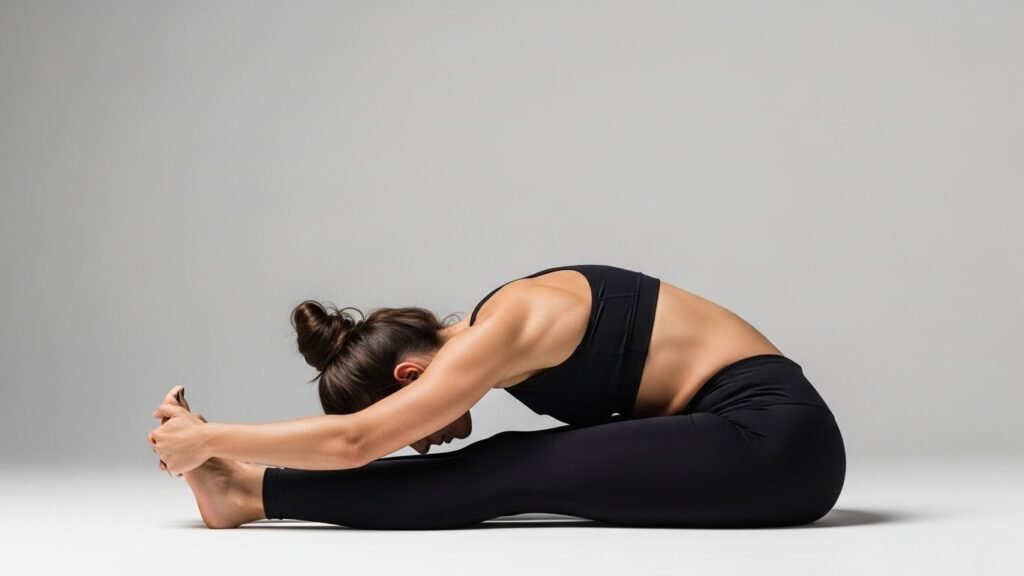
| Seated Forward Bend (Paschimottanasana) | Spine & Hamstrings | 60 seconds |
| Corpse Pose (Savasana) | Core & Abs | 30-60 seconds |
These poses open up your entire body. Combine this with a deep breathing technique for maximum benefit.
The Power of Breath: Pranayama
Breathing is the only function you can perform voluntarily, yet we rarely pay attention to it. Yoga teaches you to breathe correctly.
The Technique: Ujjayi
This is the standard Yogic breathing method.
- Inhale: Breathe in through your nose for a count of 4 seconds.
- Suspend: Hold the breath gently for a count of 7 seconds or 1 count (Kumbhaka).
- Exhale: Exhale through your nose (controlled) or mouth (forced) for a count of 8 seconds.
Do this cycle 10 times. This is one “round of Pranayama.” It will instantly slow down your heart rate and calm your nervous system.Do you feel anxious? Breathing exercises can reduce panic attacks. Read more about anxiety in our Stress Guide
Yoga for Weight Loss: The Hidden Benefit
We have discussed this in our Weight Loss Guide and Belly Fat Guide, but it bears repeating. Yoga is not a high-calorie burner like HIIT Training, but it is a powerful catalyst for weight loss.
1. The Cortisol Connection
As mentioned earlier, Cortisol causes the body to store fat, specifically in the abdominal area (visceral fat). By activating the Parasympathetic system, you naturally lower Cortisol.
2. Mindful Eating
Yoga fosters a connection between mind and body. You learn to eat when you are actually hungry, not just because a commercial came on TV. This is the secret weapon in your Healthy Snacking arsenal.
3. Detoxification
Twists and deep breathing stimulate the lymphatic system. This helps flush out toxins and reduces water retention, which leads to that “lighter” feeling.Need to drop belly fat? Combine Yoga with a healthy diet plan
Common Mistakes to Avoid
Yoga has a reputation for being “safe,” but injuries do happen—usually from beginners pushing too hard.
- Pushing Through Pain: As mentioned in our Stress Guide, Yoga should be “uncomfortable,” but never painful. If you feel sharp pain in a joint, back off immediately.
- Comparing Yourself to Others: You are not on Instagram. The person next to you is a retired Yoga teacher. Do not try to force your body into a pose it is not ready for. Honor your body’s current limitations.
- Holding Your Breath: Never hold your breath. In Yoga, the breath is your fuel. Oxygen deprivation is dangerous.
- Skipping Warm-Up: Cold muscles snap. Spend at least 5 minutes warming up your joints with cat-cow and neck rolls.
Equipment: What Do You Need?
You might think you need expensive gear to start. You don’t.
1. The Mat
This is the only essential. Use a non-slip surface. A high-quality rubber mat costs $15-$30 and saves your knees.
2. Blocks or Bricks
These are helpful for alignment. If your hips are tight in Seated Poses (like Hero Pose), sitting on a block can help you keep your spine straight.
3. Straps (Optional)
If you are very tight, Yoga straps can assist you in binds. Don’t rely on them forever; use them only to learn the correct feeling of the pose.Building a home gym? Read our Home Fitness guide for more equipment ideas
Creating Your Practice Space
Creating an environment that signals to your brain “it is time to chill” makes a huge difference in consistency.
1. The Atmosphere: Keep the room slightly warm or comfortable. Dim the lights. Light a candle. Remove distractions like your phone.
2. The Sound: Play soft music or nature sounds (rain, ocean, river). Avoid lyrical music that might trigger your mind to sing along rather than tune in.
3. The Scent: Aromatherapy is powerful. A little lavender or eucalyptus oil in a diffuser can trigger a relaxation response instantly.Need to manage stress better? Our guide covers environment design
Yoga vs. Stretching: Which is Better?
Many athletes choose traditional stretching over Yoga. We believe you should do both.
Table 2: The Recovery Routine
Here is a breakdown of how to integrate Yoga into a modern athletic routine.
| Activity | Primary Tool | Secondary Tool |
|---|---|---|
| Heavy Lifting | Foam Rolling / Active Stretching | Yin Yoga |
| Running / Cardio | Dynamic Stretching | Vinyasa Flow |
| Recovery Day | Meditation / Savasana | Sleep |
By combining heavy lifting with Yin Yoga for active recovery and Hatha Yoga for structural balance, you create an unstoppable athlete.
Conclusion: The Journey Inward
Yoga is a personal journey. It is a practice of self-inquiry. When you unroll your mat, you are making a declaration: “For the next hour, I am prioritizing my well-being.”
In a world that glorifies busy-ness, taking time for yourself is an act of rebellion. It is a way of saying, “I value myself.”
You do not need to stand on your head for an hour. You do not need to twist into a pretzel. You simply need to show up, breathe, and be present.
Start today. Even if it is just for 5 minutes. The benefits will ripple through your day, improving your General Health, enhancing your Fitness, and balancing your Macros.
Be strong in body. Be calm in mind. Namaste.