


Introduction
If you’ve been relying on bodyweight exercises alone, you’ve built a great foundation. But eventually, you will hit a plateau. Your body adapts to its own weight, and to continue growing, you must introduce an external force: Resistance.
Strength training isn’t just for bodybuilders or Instagram models. It is the single most effective method to change your body composition. Building muscle boosts your metabolism, strengthens your bones, and improves your insulin sensitivity.
Whether you are working out at home with a pair of dumbbells or hitting a commercial gym, the principles of hypertrophy (muscle growth) remain the same.
At Healthy.Azonpickr, we believe in smart training. This guide will teach you how to use resistance correctly, how to structure your workouts, and how to fuel your body for maximum gains.
The Science of Getting Stronger: Hypertrophy vs. Strength
Before you pick up a weight, you need to understand your goal. There are two main training adaptations:
1. Myofibrillar Hypertrophy (Strength):
This increases the density of the muscle fibers. It makes you physically stronger. You achieve this by lifting heavy weights for low reps (1-5 reps).
2. Sarcoplasmic Hypertrophy (Size):
This increases the volume of the fluid (sarcoplasm) in the muscle cells. It makes the muscle look bigger. You achieve this by lifting moderate weights for moderate to high reps (8-12 reps).
For most beginners, the “Sweet Spot” is the middle ground: 8 to 12 Repetitions. This balance ensures you are building both size and strength simultaneously.
Essential Equipment: What Do You Need?
You don’t need a $100 gym membership, but you do need the right tools.
If Training at Home:
1. Adjustable Dumbbells: The most versatile investment you can make. You can add or remove weight plates to increase intensity.
2. Bench: Essential for chest presses and rows.
3. Resistance Bands: Great for warm-ups and accessory work.
If Training at a Gym:
You have access to barbells, cable machines, and leg presses. This variety is excellent for targeting muscles from different angles.
Looking to build a home gym? Check out our Home Fitness guide for equipment reviews:
The Golden Rule: Progressive Overload
This is the law of the land. If you lift the same weight forever, you will not grow. Progressive Overload means you must continually increase the demands on your musculoskeletal system.
You can achieve this in several ways:
- Increase Weight: Go from 10lbs to 12.5lbs.
- Increase Reps: Go from 8 reps to 12 reps with the same weight.
- Increase Sets: Go from 3 sets to 4 sets.
- Decrease Rest Time: Rest 60 seconds instead of 90 seconds.
- Improve Form: Control the weight slower (Time Under Tension).
Track your workouts in a notebook or an app. If you aren’t tracking, you are guessing.
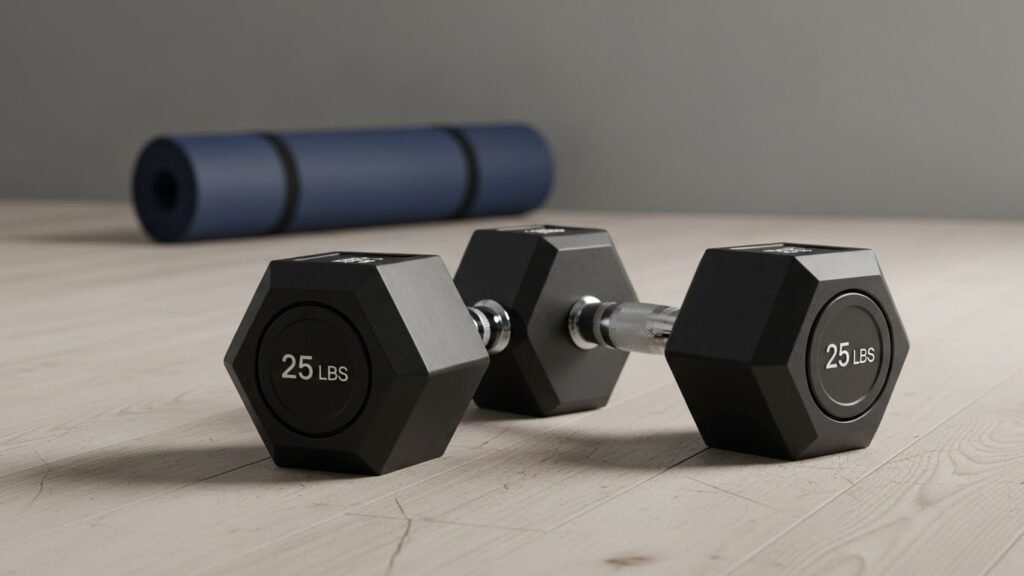
Workout A: Upper Body Strength (Push & Pull)
Perform this workout 2 times a week with at least 48 hours rest in between.
1. Dumbbell Bench Press (Chest):
Lay flat on a bench. Start with dumbbells at shoulder level. Press them up until your arms are fully extended. Lower them slowly to chest level.
- Sets/Reps: 4 sets of 8-12 reps.
2. Dumbbell Bent-Over Row (Back):
Hinge at the hips (keep back flat). Pull the dumbbells towards your hips, squeezing your shoulder blades together at the top.
- Sets/Reps: 4 sets of 10-12 reps.
3. Overhead Dumbbell Press (Shoulders):
Sit on a bench with back support. Press the dumbbells overhead until arms are extended.
- Sets/Reps: 3 sets of 10-12 reps.
4. Dumbbell Bicep Curls:
Keep elbows pinned to your sides. Curl the weight up without swinging your body.
- Sets/Reps: 3 sets of 12-15 reps.
5. Tricep Kickbacks:
Hinge forward, keep upper arm still, and extend the arm back.
- Sets/Reps: 3 sets of 12-15 reps.
Workout B: Lower Body Power (Legs)
Leg day is non-negotiable. Legs contain the largest muscles in your body, which release growth hormones that help your entire body grow.
1. Dumbbell Goblet Squat:
Hold one dumbbell vertically against your chest with both hands. Squat down until thighs are parallel to the floor. Keep your chest up.
- Sets/Reps: 4 sets of 10-12 reps.
2. Dumbbell Romanian Deadlift (RDL):
Hold dumbbells in front of thighs. Keep legs slightly straight (not locked). Hinge forward at the hips until you feel a stretch in your hamstrings, then return to standing.
- Sets/Reps: 4 sets of 10 reps.
3. Dumbbell Lunges:
Step forward with one leg. Lower your hips until both knees are at 90-degree angles. Return to standing and switch legs.
- Sets/Reps: 3 sets of 12 reps per leg.
4. Calf Raises:
Hold a dumbbell in one hand. Stand on the edge of a step. Rise up on your toes, hold for a second, then lower.
- Sets/Reps: 3 sets of 15-20 reps.
The Role of Nutrition: Eating for Size
You can train as hard as you want, but if you don’t eat enough, you won’t grow. The body requires raw materials to build new muscle tissue.
1. Protein is King:
Aim for 0.8g to 1g of protein per pound of body weight daily. Protein provides the amino acids needed for repair.
2. Eat in a Slight Calorie Surplus:
Unlike weight loss, you need to eat slightly more calories than you burn. Aim for +200 to +300 calories above your maintenance level.
3. Post-Workout Nutrition:
Within 45 minutes of finishing your workout, consume a protein-rich meal or shake. This is the “Anabolic Window” where your muscles are like a sponge for nutrients.
Struggling to balance your diet? Read our Nutrition guide for meal planning tips
Are you following Keto? You can build muscle on Keto if you keep protein high. Check out our Keto guide
Recovery: Growing While You Sleep
Remember the Supercompensation Principle: Your muscles don’t grow in the gym; they shrink. They grow while you rest and sleep, adapting to the stress you placed on them.
- Sleep: Aim for 7-9 hours. HGH (Human Growth Hormone) is released primarily during deep sleep.
- Rest Days: Never train the same muscle group two days in a row.
- Hydration: Muscle tissue is 75% water. Dehydrated muscles cramp and recover slowly.
Learn more about the science of sleep and recovery here
Common Mistakes to Avoid
- Ego Lifting: Don’t lift heavy just to show off. Bad form leads to injury. Leave your ego at the door.
- Ignoring Compound Movements: Don’t waste all your time doing “bicep curls.” Squats, deadlifts, and presses give you the most bang for your buck.
- Not Warming Up: Cold muscles snap. Spend 5-10 minutes doing light cardio and dynamic stretching before lifting.
Conclusion
Strength training is a journey of self-discipline. It is about challenging yourself physically and watching your mind become stronger along with your body.
Start today. Pick up those dumbbells. Do one set more than you did last time. That small increment is the secret to long-term success.
Your health, your metabolism, and your confidence will thank you.